Phase 1: Planning Your Shift
What is the issue?
You’ve set your course with three big goals and chosen 3-9 tactics to support them. But how do you know if these tactics are effectively moving you towards your goals?
How can you measure your progress and stay motivated? This is where objectives come into play – they're the precise coordinates that help you navigate from your current position to your destination.
What do you think?
Consider one of your chosen tactics, perhaps something like "eat less processed food." How would you know if you're successfully implementing this tactic? What would progress look like?
Now, imagine transforming this tactic into a more specific objective: "Replace my daily afternoon vending machine snack with a piece of fruit, five days a week for the next month." How does this change your perspective on implementing the tactic?
In your Captain's Log, jot down your thoughts on the difference between these two approaches. What advantages do you see in the more detailed, measurable objective?
Also consider that meeting each objective on its own isn’t meant to get you all the way to your goal. The Shift is designed to reduce overwhelm and resistance to getting started from day one. This means that you’re going to start just by looking for the next objective, or waypoint, not the bigger, broader goal.
What else would be good to know?
SMART is an acronym that stands for Specific, Measurable, Achievable, Relevant, and Time-bound. These criteria transform your tactics into clear, actionable objectives. Let's break them down using the tactic "eat less processed food" as an example:
Specific: Your objective should precisely describe what you'll do. Instead of just "eat less processed food," specify exactly what change you'll make, such as "replace my daily afternoon vending machine snack with a piece of fresh fruit."
Measurable: Include concrete criteria for measuring progress. For our example, this could be "track the number of times per week I choose fresh fruit over processed snacks."
Achievable: Your objective should stretch you but remain possible. If you currently eat processed snacks daily, aiming to eliminate them entirely might be unrealistic. A more achievable objective might be "replace processed snacks with fresh fruit 4 out of 7 days a week."
Relevant: Your objective should directly support your larger goal. If your goal is to improve overall health, reducing processed food intake is clearly relevant.
Time-bound: Set a clear timeframe. "I will replace my afternoon vending machine snack with fresh fruit 4 days a week for the next month" gives you a specific endpoint to work towards.
TACTIC + OBJECTIVE = STRATEGY
<>
TACTIC + OBJECTIVE = STRATEGY <>
Objectives take your tactics and give them structure and clarity.
That is, a tactic wrapped into an objective is a strategy.
They're like plotting specific coordinates on your nautical chart – they tell you exactly where you're heading and how you'll know when you've arrived. Every time you reach a new coordinate it is like a marker of moving closer and closer to your goal.
Remember, we're not talking about goals here – your three big goals remain your overall destination. Objectives are the specific, measurable steps you'll take to implement your tactics and move towards those goals.
How do I apply this right now? How do I explore this more?
Let's put these concepts into practice with an exercise designed to help you create objectives but with a twist: commitment statements.
In The Shift, we use the Above Water Mind to create action in the direction of our 10/10 Life.
Framing each objective as a commitment immediately inspires the Above Water Mind to plan for action in a way that is more powerful than just determining the technical components of an objective or finding room in your calendar.
This next activity will guide you through the process of transforming your 12 chosen tactics into objectives and commitments to those objectives.
For example, if your tactic was "drink more water," your objective might be: "I will drink 8 glasses of water daily for the next 30 days, tracking my intake using a water bottle with marked measurements."
However, your commitment statement would be: “I will drink 8 glasses of water on a daily basis for the next 30 days. I will know if I have met the objective by tracking my intake using a water bottle with marked measurements. This will bring me closer to my Life Weight Goal which is 200lb so that I can live my 10/10 Life.”
This hits differently, doesn’t it?
Your Above Water Mind definitely thinks so.
You will repeat this process for all 9 of your tactics, creating a SMART objective and commitment statement for each one.
You may stop reading the lesson and do these activities now or wait until the end of the lesson to do the activities in sequence.
Once you complete this lesson, the activities will appear on their own pages so you can find them and repeat them anytime.
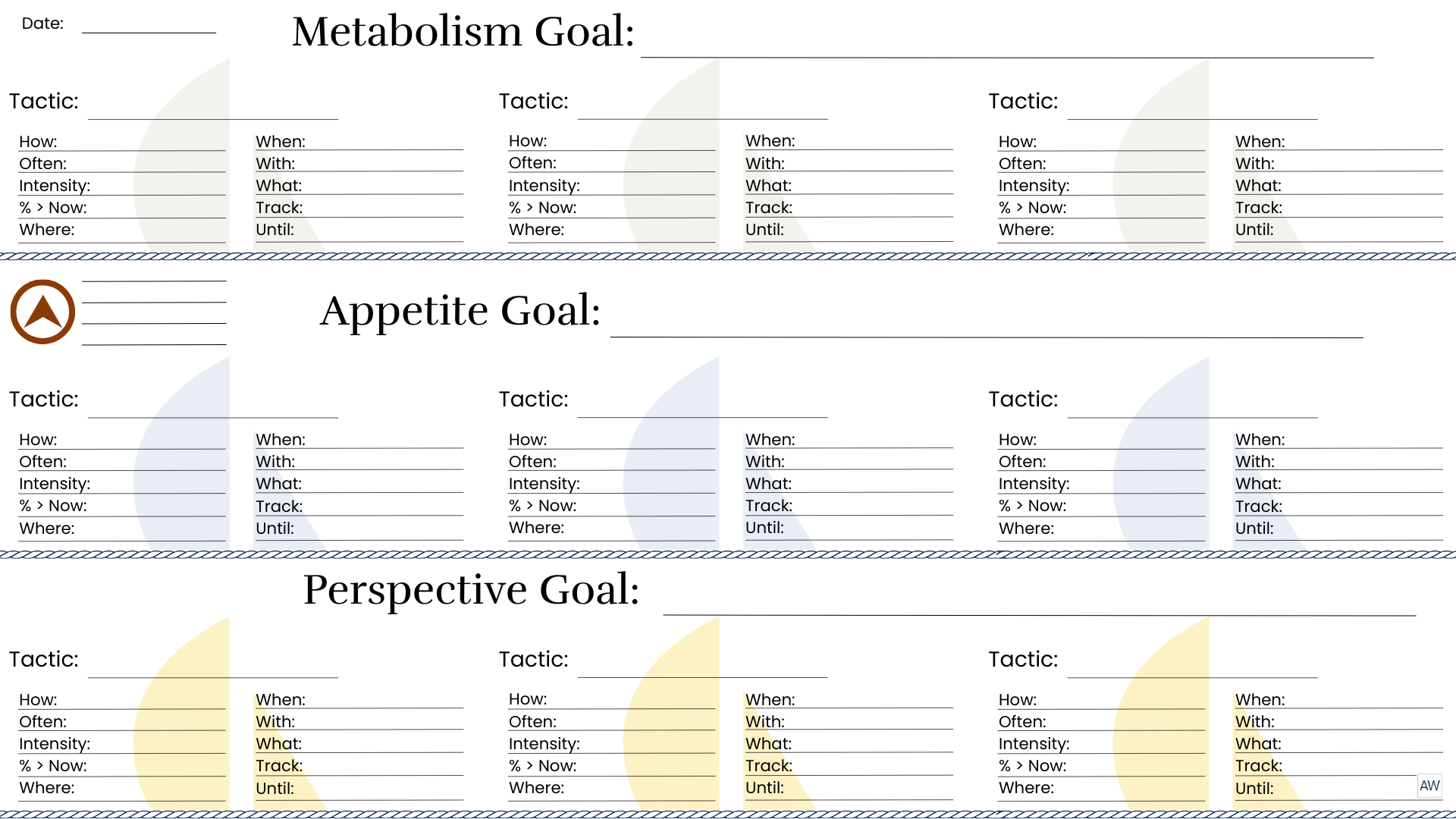
If desired, you can work through your objectives on this PDF download. You may prefer to use the digital activity (#1 below) and then display your objectives using the PDF.
This worksheet asks slightly different questions than the digital activity below to arrive at the objectives. You may prepare to revise it after your Reality Test (below).
Activity 1:
Turn Tactics into Objectives
By the end of Phase 1, you will have created space in your life and calendar for your goals. You will have made commitments to achieving these goals by focusing on smaller objectives made up of repeating and revising tactics. You will celebrate the practice and the effort as much as, or even more, than the results. You will be committed to meeting your objectives.
How do I bring it all together?
Once you've created your objectives, you have made a commitment to yourself.
It's important to ensure that you create space for them in your life.
The most straightforward way to do this is to give each objective a home in your schedule and then test them over a little bit of time.
Remember, your objectives are like the coordinates on your nautical chart. They give you clear waypoints to navigate towards, helping you stay on course even when the seas get rough.
Activity 2:
Reality Test Your Objectives
Open your planner, calendar, or digital organizing tool. Is it open?
Schedule the tactic on which the objective is based as a recurring event (daily, weekly, monthly, etc) in your planner, calendar or digital planning tool. While you are scheduling, set a reminder or reminders for the tactic. Did you schedule the tactics and reminders?
Ok, now go live your life. If your objective has a daily time frame, do the activity below after 1-2 days. If the objective has a weekly time frame, do the activity below after one week. If the objective has a monthly time frame, do the activity below after one month. You get it.
After the time frame has elapsed, do Activity 2 to Reality Test and evaluate if there is too much friction between your objectives and your life and you will decide which of these to shift: objectives or life.
Activity 3:
The Complete Shift Strategy Worksheet
Values, Goals, Tactics, Objectives and Commitments on one page.
Activity 4:
The Shift Tracker
This is a downloadable PDF. You can use it to track commitments on a daily, weekly or monthly basis. Each sheet allows you to track 6 commitments. You can keep them in a folder to see a record of your progress over time.
How will I know if this is making a difference? How do I start noticing the changes?
You’ve now built everything from values to 10/10 Life.
As you begin your strategy, you might notice some changes:
Increased clarity: You'll have a clearer understanding of exactly what actions you need to take each day.
Tangible progress: With specific metrics, you'll be able to see your progress in concrete terms.
Improved focus: You may find it easier to prioritize actions that directly contribute to your objectives.
Greater motivation: Achieving clear, measurable objectives can boost your confidence and motivation.
Keep track of these changes in your Captain's Log. Regularly reviewing your progress not only helps you stay on course but also allows you to celebrate your victories, no matter how small.
What is next?
Remember, setting strategy is a skill that improves with practice. Don't worry if your first attempts feel a bit clumsy – like learning to read nautical charts, it gets easier with time. The key is to start, adjust as you go, and keep your destination in sight.
Trust in the course you've set, but remain flexible and open to adjusting as you gain new insights along the way.
You are ready to move on to Phase 2. This is where we visit the Below Water Mind.